Quick take: Build an AI visibility prompt list from your business priorities, not a tool’s auto-suggestions. Start with the services, verticals, and locations you want to win, then pull real questions from sales and support conversations. Use AI to draft and categorize prompts, vet each one by hand, and review the list quarterly.
Imagine searching for your business and finding not just web results, but your brand recommended in AI-powered conversations and answers. That’s the new reality of online visibility, where artificial intelligence guides more and more customer journeys. The question isn’t just, “Are you ranking?” It’s, “Are you being mentioned, recommended, and trusted in the moments that matter?” The foundation for this new visibility is building the right set of AI visibility prompts, rooted in your real business priorities.
Start With Your Priorities
Before you start generating or tracking prompts, clarify what matters most for your business. AI visibility isn’t just about appearing for your brand name. It’s about staying present in the questions your ideal customers are asking.
What Should You Track?
Start by identifying the outcomes you want from AI visibility. Here are a few common objectives:
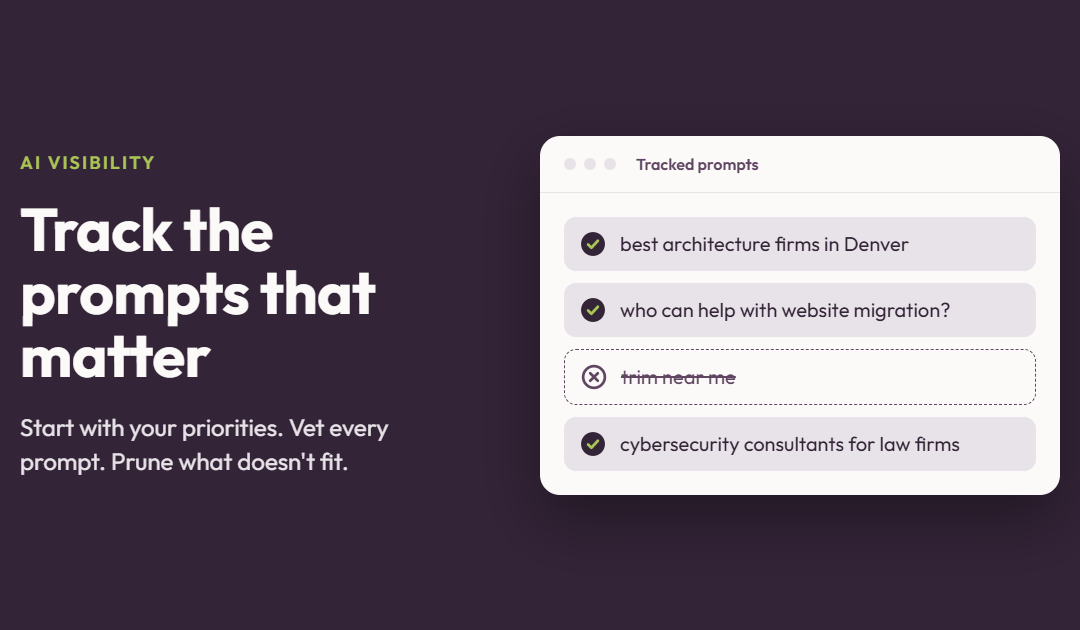
- Transaction-intent terms for services or capabilities: Prompts that signal someone is close to making a purchase or decision. For example, if you’re a digital marketing agency, you might want to show up for prompts like “best agencies for B2B SEO” or “who can help with website migration?”
- Visibility among specialty verticals: If your business serves niche markets, you’ll want prompts customized to those audiences. For instance, “cybersecurity consultants for law firms” or “enterprise data centers in Austin.”
- Location-based brand exposure: If geography matters, prompts like “top architecture firms in Denver” ensure you’re considered in local searches.
Ask yourself: What kind of customers do you want to attract? What services or products are most important for growth? Which market segments matter most to you? Your answers will drive the prompts you create and track.
With your priorities clear, you can move forward with a focused strategy that saves time and generates more meaningful insights.
Avoid the Common Pitfalls: Don’t Rely on Auto-Generated Prompts
Many businesses start by relying on their AI tool’s built-in prompt suggestions or asking the AI to generate a list of relevant prompts. While this can kickstart the process, it’s rarely comprehensive or strategic. Even if your business has a strong website and strong digital footprint, no tool understands your unique goals and priorities better than you do.
Overreliance on auto-generated prompts often means you’ll track irrelevant queries or miss out on high-value opportunities. Instead, take the time to customize your prompt list around what matters most for your business. Your insights will always outperform any generic tool.
A Strategic Approach to Prompt Development
Let’s break down a practical, step-by-step method to build prompts that reflect your real business goals.
1. Define What You Want to Measure
Begin by outlining what you want to measure. For most businesses, this includes:
- Appearing for non-branded, high-intent service or capability prompts, often narrowed by location, industry, or audience.
- Understanding how your brand appears in AI tools, including sentiment, accuracy, and whether it’s identified correctly.
- Comparing your brand to competitors: Who else is mentioned in results? How do you stack up?
2. Collect Insights From Real Conversations
Whenever possible, tap into your sales team, customer service reps, and subject matter experts. Review transcripts of customer calls and sales conversations to uncover the real questions your prospects are asking. These insights are gold. If people are asking these questions in real life, they’re almost certainly prompting AI tools with them, too.
Additionally, ask about recurring questions, industry certifications, or unique specialties that set your business apart. Aligning your prompt tracking with authentic customer language leads to more accurate and actionable results.
3. Use AI Tools to Draft and Categorize Prompts
Once you have your priorities and some customer insights, use your AI tool to generate a draft set of prompts. Point the tool to your website, strategy documents, and any other relevant resources. Explain your priorities so the tool can customize its suggestions. Categorize the resulting prompts by theme, such as transactional, informational, or competitor-related, so you can easily manage and monitor them.
4. Manually Vet and Refine Your Prompts
Don’t accept every prompt the tool generates without question. Go through each one and make sure it’s relevant, specific, and consistent with your business goals. Ask yourself:
- Does this prompt reflect what we want to be known for?
- Is it too broad or too niche?
- Are there confusions that could lead to irrelevant results (e.g., “trim” returning results about haircuts or car interiors instead of exterior house trim)?
Flag any doubts for clarification, especially around certifications, specialties, or services that might not be central to your offering.
5. Review and Prune Regularly
Prompt tracking isn’t a one-and-done process. After a few tracking cycles, review the responses your prompts return. Are they surfacing the right kind of mentions? Are you seeing your business compared to the right competitors? If irrelevant results come up, adjust your prompts for clarity and specificity.
For example, if your prompts bring up unrelated businesses or industries, tweak the language to match your target market more closely. Regular pruning ensures your tracking stays meaningful and actionable.
What to Track for Each Prompt
A good prompt list is only half the work. You also need a consistent way to record what each prompt returns. For every prompt, note:
- Mention: Is your business named in the answer?
- Citation: Does the answer link to your website as a source?
- Position: Are you recommended first, buried in a list, or mentioned in passing?
- Accuracy and sentiment: Is the information about you correct, and is it framed positively?
- Competitors: Who else appears, and how often?
Mentions vs. Citations
These two are easy to confuse, but they measure different things. A mention means the AI tool named your business in its answer. A citation means it pointed to your website as a source. You can be cited without being recommended, for example when your blog post answers an informational question, and you can be recommended without being cited. Both matter: mentions show that AI considers you a relevant option, and citations show that it trusts your content.
Expect Answers to Vary
AI tools don’t return the same answer every time. Responses can change from day to day, and ChatGPT, Perplexity, Gemini, and Google’s AI Overviews often give different answers to the same prompt. One check isn’t enough. Track the same prompts across several platforms over time, and look for patterns rather than reacting to any single result.
How Many Prompts Should You Start With?
You don’t need hundreds. A focused set of 25–50 prompts tied to your top priorities is enough to reveal meaningful patterns. You can expand once you know which areas need the most attention.
Measuring Search Volume for AI Visibility Prompts
One challenge with AI prompts is appreciating their impact and reach. Some tools, like Google Search Console, offer proxies for prompt volume. Long-tail search data and impressions can hint at how frequently certain queries are used. Dedicated AI prompt tracking tools sometimes estimate “monthly search volume” for each tracked prompt, though these are often based on modeled data, since most AI interactions are private.
Focus on prompts likely to produce meaningful business outcomes. For instance, while informational prompts (“how much does it cost to hire a security consultant?”) can be interesting, they’re less likely to lead to direct recommendations. They can still earn citations to your content, so track a smaller set of them alongside your high-intent prompts. Prioritize prompts that are more likely to connect users with your business.
Supplemental Prompt Exercises
Beyond routine monitoring, consider periodic exercises to:
- Test how well AI tools understand your brand and its key differentiating features.
- Don’t confuse it with similarly named companies (entity disambiguation).
- Compare your visibility to competitors.
- Assess local or vertical-specific presence.
These exercises can reveal new insights, especially as AI search evolves and user behaviors shift. Continually assessing your prompt set ensures you adapt to changes rather than fall behind.
Do You Need a Comprehensive Research Project?
A common question: Should you invest in a major research project to create the “perfect” prompt list? The truth is, balance is best. Don’t stall prompt development waiting for the stars to align. If you already have valuable insights from your team or customers, put them to use right away. Stay agile, and keep your process flexible and iterative as your business and market evolve.
Key Takeaways
If you’re refining your approach or just getting started, keep these main points in mind:
- Define your priorities first. Know what you want to be known for and where you want to appear.
- Use real customer language, along with insights from sales conversations, to guide prompt development.
- Leverage AI tools for drafting, but always vet prompts manually for relevance and specificity.
- Consistently review and refine your prompts based on the results you see.
- Prioritize high-intent prompts, and track mentions and citations across platforms over time rather than relying on a single check.
- Supplement your routine tracking with focused competitor, brand accuracy, and local or vertical checks.
Frequently Asked Questions (FAQ)
Have more questions as you shape your AI visibility strategy? Here are some practical answers to help you move forward with confidence.
What are AI prompts for business visibility?
AI prompts for business visibility are specific questions or phrases that mirror what your customers ask AI search engines and conversational tools. By tracking how your company appears in response to these prompts, you can assess and improve your presence in AI-powered results beyond traditional web search rankings.
How do I track my brand in AI search engines?
To track your brand in AI search engines, start by developing a curated list of prompts that reflect your key services, specialties, and target markets. Use AI tracking tools to monitor how your business is mentioned or recommended in these contexts. Regularly review and refine your prompts to capture the most meaningful and relevant moments when your brand should appear.
Why is manual review of AI prompts important?
While AI tools can generate draft prompts, manual review is essential to ensure each prompt aligns with your unique business priorities and avoids irrelevant or misleading results. Vetting prompts lets you catch nuances, correct for industry-specific language, and focus your tracking on what actually drives visibility and business growth.
How often should I update my AI prompts?
AI search behaviors and algorithms evolve quickly. Review and update your prompt set quarterly, or whenever you launch a major new product, enter a new market, or notice shifts in customer language. This keeps you visible and relevant as trends change.
Ready to Take Your AI Visibility to the Next Level?
AI-driven search isn’t just a trend; it’s a shift in how people discover and choose businesses. By developing thoughtful, business-driven prompts, you can ensure your brand shows up where it counts. Start by defining your goals, listening to your customers, and improving your approach as you go. If you’re looking for tailored guidance or want to discuss how these strategies can work for your business, the team at Huckleberry Branding is always open for a conversation about your SEO and AI visibility goals.